
Klippe en beelde uit die Karoo
Renée Swanepoel – August 28, 2026
Klippe en beelde uit die Karoo – Dr Hannes Loots
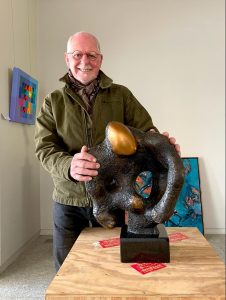
Dr. Hannes Loots is ’n afgetredene wat vir 20 jaar lank as ’n narkotiseur in Port Elizabeth/Gqeberha gewerk het. Hy het homself ook as beeldhouer bekwaam. Hy het saans vir vier jaar lank Beeldhoukuns aan die destydse P.E. Technikon bestudeer. Hierna het hy ook tyd in ’n beeldhou-ateljee in Italië deurgebring waar hy nog geleer en gewerk het.
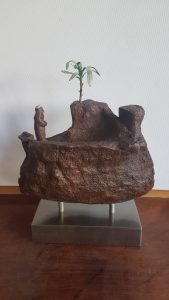
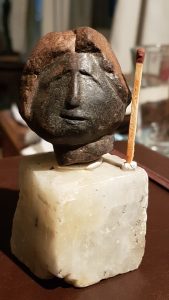
Hierdie boerseun van Beaufort-Wes kan ’n kunswerk in ’n klip “sien”!
Die beeldhouer, Hannes Loots aan die woord:
“Die klippe in die Karoo kan beelde word en met die verbeelding vriende maak, sodat die ingeboude verbeelding, wat ons almal tog het, kan verbeel en sien. Om van kuns te praat beteken onder andere die volgende:
- Anything can be art – a pile of tyres, an unmade bed: who says these are not art?
- Art consists in our singular capacity to use our imagination – to see and to imagine – Nigel Spivey
- Works of art are essentially vehicles for expression and speculation
- A work of art is poetry in concrete form – Bruce Murray Arnott
Die groot uitdaging wat ek graag wil uitbeeld, is om te kyk en te sien – to perceive by the eye.
“To look is an intentional action where you turn your eyes toward something, while to see is a passive, automatic process of perceiving something with your eyes without trying. You choose to look, but you simply see what is in your field of vision. Agree, that you can look at something and still not see it.”
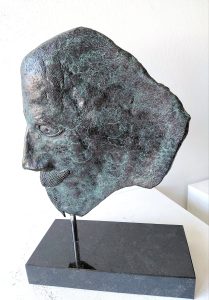
Verder sal ek graag ’n bietjie wil verduidelik hoe word ’n bronsbeeld gemaak m.a.w. hoe kry ek ’n klip in brons?
Bronze casting: lost-wax casting – involves creating an original sculpture, making a flexible rubber mold, pouring a hollow wax replica, building a ceramic shell around it, melting out the wax, and finally pouring in molten bronze.
The ceramic shell is dried for 7 days, after which it is hard enough to receive molton bronze.
The crucible is loaded with bronze ingots and heated to 1400 degrees. The molton bronze is poured into the investment mold and time is allowed for the metal to shrink as it cools, before the ceramic shell is chiselled off to expose the cast.
Hierna het ons ’n rowwe bronsbeeld wat dan verder afgewerk (fettling) en op plekke gesweis word waar daar merke of krake is. Die beeld word dan met hoëdruk sand gespuit (sandblasting) om daarna gepatineer te word:
To patinate means to cover or become coated with a thin layer of colour, film or oxidation (called patina) on metals, wood or stone. The process happens over time through weather and age or artificially through chemical treatments. Ons maak die beeld weer taamlik warm en spuit oplosbare metale soos bv. sulphfur ((for dark brown/black) or ferric cupric nitrate (for reds, browns and greens). Dan word die beeld, nadat dit afgekoel het, met deurskynende politoer geseël.
Montering op ’n voetstuk
Die vertoon van ’n beeld op ’n voetstuk is nogal belangrik en soms moeilik om reg te kry. Hout, sandsteen, klip, marmer of graniet word gewoonlik gebruik. ’n Voetstuk vir ’n beeld kan ook in brons gegiet word en dan ook gepatineer word.
Die koste verbonde aan beeldhouwerk in brons is hoog a.g.v. die vele prosesse en handewerk daaraan verbonde asook die koste van die metale waaruit die brons gemaak word.
David (Michealangelo)
 The massive block of white marble that was to become David, measuring 17.1 ft (5,2m) in length, was of bianco ordinario grade marble, rather than the superior statuario. It came from the old Roman Frantiscritti quarry at the centre of the Carrara marble basins, and had been transported to the sea by oxen-pulled carts, whence it was carried on barges dragged by oxen up to the river Arno and on to Florence.
The sculpture is 5.17 m high and weighs approximately 5.5 tons. (The original block marble weighed 8 tons.)
David is a masterpiece of Italian sculpture in marble created from 1501 to 1504 by Michealangelo.
He chiselled layer after layer from the main face of the stone, and then gradually more and more of the other sides.
David was originally commissioned as one of a series of statues of the twelve prophets to be positioned along the roofline of the east end of Florence cathedral, but was instead placed in the public square in front of the Piazza della Signoria, the seat of civic government in Florence, where it was unveiled on 8 September 1504. In 1873 the statue was moved to the Galleria dell’Accademia, Florence. In 1910 a replica was installed at the original site on the public square.”